
FINDING MY VOICE: Ainslie Paton
Finding My Voice
Ainslie Paton
Oh baby, I had a writer’s voice. I had dozens of ‘em. And that was the problem.
I’ve been paid to write for a lot longer than I’m prepared to admit. I’ve written as the CEO under pressure delivering serious financial results. I‘ve written as the journalist reporting on a business scandal. I’ve written as the concerned stakeholder, the outraged shareholder, the confused consumer, the dickhead employee. I’d written in all those voices and more for dozens of different audiences.
I know how to get read in a variety of forms and mediums from ad copy to film scripts. But long copy, narrative form—my own voice, not impersonating someone else? Holy no-hoper. I had no idea. I only knew that to assume because I could do one kind of writing, I could do the other too, could be a world of hurt.
The principles are the same, the methods and disciplines, but the sound, it’s not called voice for esoteric reasons. It comes down to the choice and the placement of words on the page and how they echo and resonate in a reader’s head. It’s song without music, lyrics without tune, but it’s a composition all the same.
My voice was professionally schizophrenic. I had no idea if I could tell a story that was coherently, uniquely mine and make it enjoyable, and then do it again, and again, until I had something that was reliably consistent in its style and ambition, and its promise to a reader.
I wanted my voice to be cracky. And by cracky I mean I wanted it to be sticky and grabby and compelling, not necessarily polite. I wanted to write page-turners, stay-up-all-nighters, miss-the-bus-stoppers. And I wanted them to say something about how people stand up and fall down and learn to live with a limp. I wanted humour and pathos and that indefinable stuff that makes the back of your throat go tight and your eyes itch; that makes you want to hug your kindle. Or throw it across the room. Either way, to be memorable.
And the only tools I have to use are words, strategically place hieroglyphics and the occasion of white space. Here lies madness and certain repetitive strain injury.
Because here’s the thing. I have about as much experience as your average naked man with a very small towel in a sauna with writing descriptive language. If you asked me to describe a raindrop, I’d call it wet. Not a lot of pathos or humour in that. Then there’s dialogue. Not a lot of dialogue goes in your standard press release or annual report. I could ace monologue, but two monologues don’t make a conversation anyone with blood pressure would want to read.
So I had these voices and these skills gaps—and I still do. Raindrops are still wet where I come from, and dialogue is still more than one person talking. How very inconvenient.
It took time to relocate my voice in a long form fictional setting. We’re still on that timeline and I’m still changing, learning, moving into different neighbourhoods. I wrote first person first, because I knew I wouldn’t get into too much trouble that way. Trouble beckoned. I wrote shifting third person point of view, hiss, scratch, also called head-hopping with trace elements of omniscient voice, (Nora land, Amy Andrews land) and that was enormously exciting, but I wanted to go deeper. I now mostly write deep limited third person point of view with potentially revealing schizophrenic tendencies.
And the voice itself, it’s a little crisp, it’s a little snarky, it’s spare, it’s got an upside of crack and a downside of oh Amazon this is boring, kill me now. And every day, every word; its selection and placement, is the challenge that will build and maintain my fictional author’s voice.
Or dictionary, thesaurus, spell-check, get arthritic hands trying.
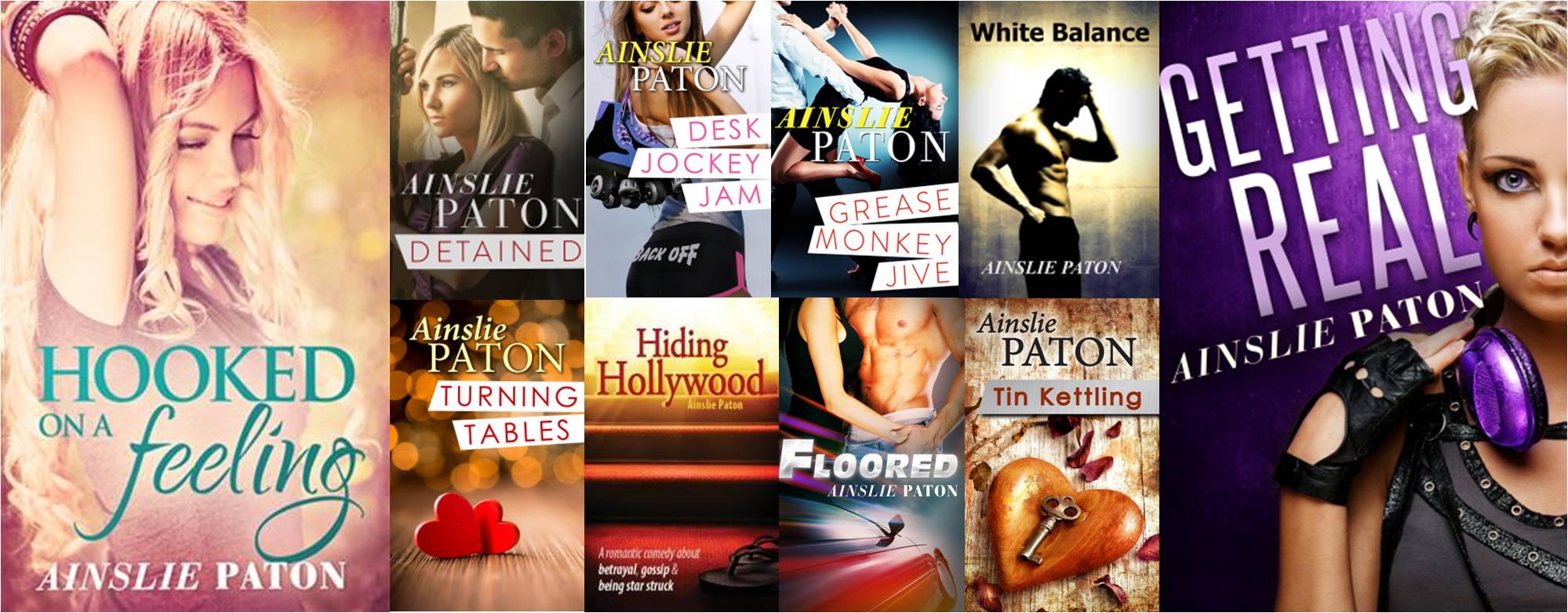
Hooked on a Feeling
Ainslie Paton
From Ainslie Paton comes a groovy romance about changing times, growing up, breaking out and second chances. Set in Sydney in 1975, when pants and collars were wide, hair was big, eyelids were blue and neighbours shared each other’s lives.
There’s a sexual revolution going on, but not in Gayle’s life. She’s never felt so old, so unattractive, and so helpless. Your husband asking for a divorce could do that to you. Now she’s the scandalous new neighbour, the single mum, the divorcee, who needs a job but doesn’t know how to balance her own cheque book.
And then Steve and Ray arrive in her life, the former with chocolate hair and hurt eyes, the latter with a tomboy daughter and an uptight attitude. Suddenly, being separated doesn’t feel so shameful. This is the story of how Gayle lost her home to find true friends; her marriage to find a new life; and her husband to find love.
About the Author:
Ainslie Paton is a corporate storyteller working in marketing, public relations and advertising. She’s written about everything from the African refugee crisis and Toxic Shock Syndrome, to high-speed data networks and hamburgers. She writes cracking, hyper-real romances about strong women and the exciting men who love them. She lives in Sydney, Australia.
Find Ainslie online:
Website
Facebook
Twitter
Google+
YouTube



 AusRomToday
Leave a comment